
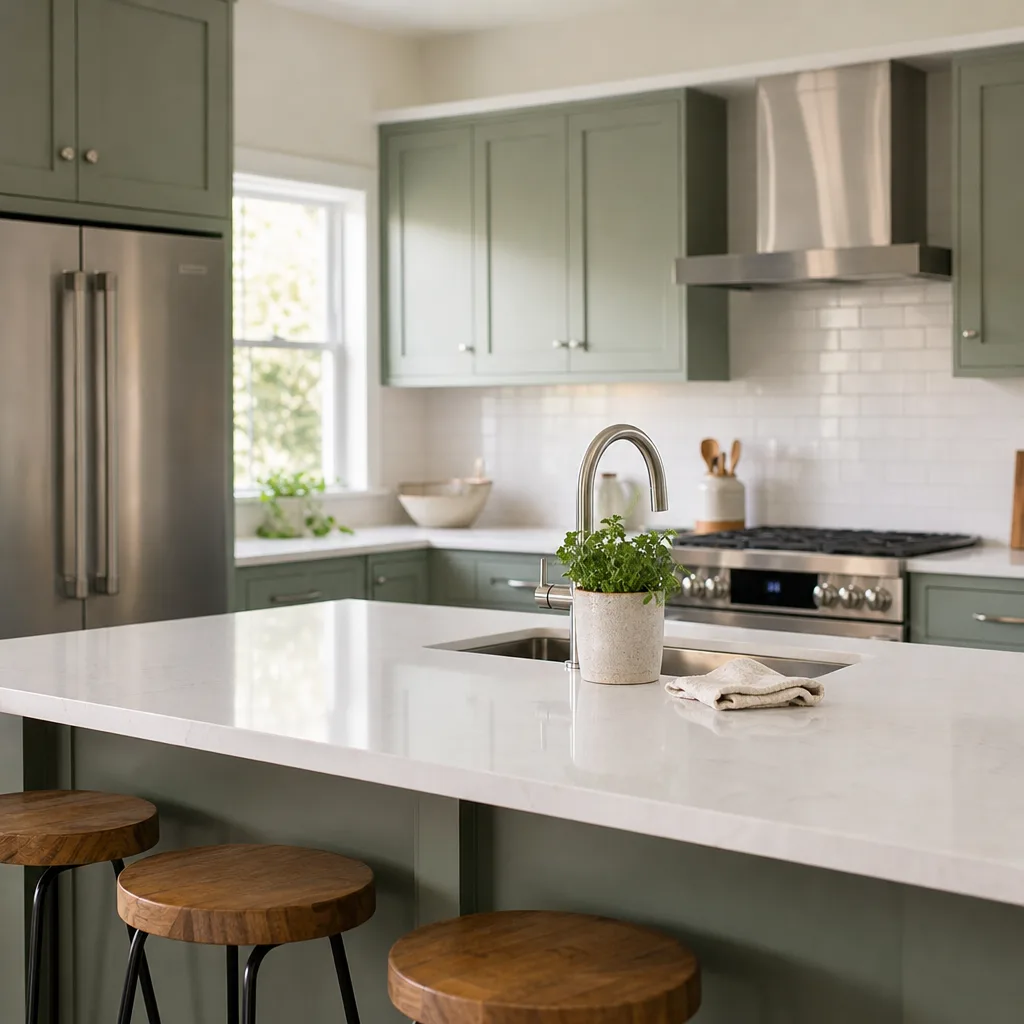
Signs Your Kitchen Is Ready for New Quartz Counters
Most counters don't fail all at once. They give you small warnings first, like seams that won't stay clean, soft spots near the sink, or stains that come back a week after you scrub them. When those warnings start stacking up, replacement usually costs less headache than another round of repairs.
You don't need a contractor to tell you your counters are tired. You already know. You're the one wiping the same spot twice a day.
Here's what we'd look at first if we were standing in your kitchen with you.
- The seam near the sink is dark and won't come clean. That's water getting underneath and sitting there. On laminate, that means the particleboard core is swelling. Once it swells, no amount of caulk fixes it.
- You press near the sink cutout and the surface gives a little. Soft means wet. Wet means the substrate is already breaking down.
- Stains keep coming back. Coffee rings, red wine, turmeric, a tomato sauce splash from three weeks ago. Unsealed or under-sealed stone soaks things up. If you're resealing and still fighting stains, the surface has lost the battle.
- There's a chip or crack at the edge of the sink or cooktop. Those are the weak points on any counter. A chip there tends to grow, not stay put.
- You're planning a new sink, a new faucet, or a cooktop swap. Old counters rarely survive being cut or re-drilled. If a change is coming anyway, that's the moment to think about quartz.
- You hate looking at them. That's a real reason. You spend more waking hours in the kitchen than almost any other room in the house.
Leesburg has a wide spread of housing. Homes near the historic district downtown often have original kitchens patched by three different owners over the years. Newer builds toward the edges of town came with builder-grade laminate or a thin engineered surface never meant to last twenty years. Both end up in the same place. The counter does its job on the surface while quietly failing underneath.
Humidity plays a part here too. Northern Virginia summers get sticky, and kitchens hold that moisture. A counter with an open seam or a compromised edge takes on water all season, then dries out over the winter. That cycle loosens adhesive and widens gaps a little more each year. It's why a small seam problem in June often looks worse by the following spring.
One more thing worth checking. Look underneath the counter, inside the sink cabinet. Grab a flashlight. If you see dark staining on the underside of the deck, warped wood, or a musty smell, the damage is further along than the top surface suggests. That's the point where new counters stop being a want and start being a fix.
If you counted two or three of these in your own kitchen, quartz countertop installation is worth a real conversation. It's a nonporous surface, so the stain-and-reseal cycle ends, and the seams get set once and stay put.
Review stunning interior remodeling options in Leesburg.
How Quartz Compares to Granite for a Kitchen Update
This is the question we get most once somebody decides their old counters are finished. Quartz and granite land in the same part of a kitchen budget, and both will outlast whatever you're pulling out. They just behave differently once they're living in your house.
Granite comes out of the ground in slabs and gets cut, polished, and sealed. Quartz is engineered. Ground natural quartz gets mixed with resin and pigment and pressed into a slab. That one difference in how they're made drives almost every other difference you'll notice.
Here's what matters day to day:
- Porosity. Quartz is nonporous, so liquid sits on top until you wipe it. Granite has tiny pores and needs sealing to keep coffee, oil, and wine from soaking in. Sealer wears off, so that's a task that comes back around.
- Consistency. A quartz slab looks like the sample. Granite is natural rock, so the slab you get may have more movement, different veining, or color shifts the sample didn't show. Some people love that. Some people are unhappy the first time they see it installed.
- Seam appearance. Quartz patterns are made in a factory, so seams are easier to line up and hide. Granite veining runs where it wants, and a seam through heavy movement is harder to disguise.
- Heat. Granite handles a hot pan better. Quartz has resin in it, and resin doesn't love direct heat. With quartz, you use a trivet. That's the whole rule.
- Sunlight. Strong, constant UV can fade the resin in quartz over years. If you've got a slab running under a big south-facing window or into a sunroom, granite is the safer call.
- Edges and cutouts. Both cut cleanly, but quartz tends to chip less at sink and cooktop edges because the material is uniform all the way through.
For most Leesburg kitchens we work in, quartz wins on the maintenance side alone. Northern Virginia summers push humidity into the house, and a sealed natural stone in a heavily used kitchen is one more thing you have to keep up with. Quartz asks for soap and water and nothing else.
Granite still makes sense in plenty of houses. If you want a slab nobody else has, if you cook hot and fast and hate reaching for a trivet, or if you're putting stone in a room that gets baked by afternoon sun, natural stone is the better fit. Homes near the historic district downtown sometimes call for it too, since a natural stone edge profile can sit more comfortably with older cabinetry and trim than a crisp engineered look does.
One thing to keep in mind on cost. The slab price is only part of the number. Fabrication, the number of seams, edge profile, sink cutouts, and whether the old counters need demolition and substrate repair all move the total. Two kitchens with the same square footage can land far apart. When you get quotes, ask what's included in each line so you're comparing the same scope, not just the same material.
We install both, and we'll tell you which one fits your kitchen after we see how it's laid out, how you cook, and where the light comes in.
When Quartz Is Not the Right Choice
We'd rather talk you out of quartz now than hear about it a year later. There are kitchens and homes where it's the wrong answer, and a few where it's the right material at the wrong time.
Start with where the counter is going. Quartz belongs indoors. An outdoor kitchen, a covered patio bar, a screened porch prep counter, or a grill island is not the place for it. According to MSI Surfaces,[1] the resin that holds the slab together doesn't handle sun and freeze-thaw well, and Loudoun County gives you both in the same year. Same story for a sunroom counter or a long run of counter sitting under a wide south-facing window with no shade. That's a natural stone job.
Then think about how you cook. If you're someone who pulls a cast iron pan off a 500-degree burner and sets it down wherever there's room, you're going to be unhappy with quartz eventually. We can tell you to use a trivet, and you'll agree in the showroom, and then it's Tuesday night and dinner's late. Be honest with yourself. Some people are trivet people and some aren't.
There are also times to wait, even when quartz is the right material.
- Your cabinets are shot. Quartz slabs are heavy, and they need a level, solid base. If the boxes are sagging, water damaged, or you're planning to replace them within a couple of years, do the cabinets first or do both together. Installing stone on cabinets you're about to tear out is money you'll spend twice.
- There's an active leak. A dripping supply line or a slow drain leak under the sink has to be fixed before anything gets set on top of it. New counters don't stop water, they just hide it.
- You're mid-layout change. If you're still deciding whether to move the sink, add an island, or open a wall, hold off. Templating happens after the layout is final, and reworking a slab after the fact usually means a new slab.
- The counter is fine and you just want a new look. If the surface is sound and the only problem is the color, refinishing or refacing the cabinets around it may get you further for less.
- You're selling in a few months. A basic, clean, durable surface may be plenty for a buyer. Full stone in a kitchen you're leaving doesn't always come back to you.
One more case worth naming. Small bathroom vanities and powder rooms sometimes make more sense in a simpler surface. You're covering a few square feet, the fabrication and cutout costs don't shrink much with the size, and the wear on a guest bath counter is nothing like a kitchen. That's not a reason to avoid quartz there. It's just a reason to ask whether the money does more somewhere else in the house.
If any of that describes your situation, say so when you call. We'd rather sequence the work right than sell you a slab this month.
What Happens on Template and Install Day
Quartz goes in over two visits, not one. First somebody comes out and measures. Then the slab gets cut at the shop. Then a second crew comes back and sets it. Most people picture one day of work, so the gap between those visits is the part worth understanding up front.
Template day is the measuring visit. Your old counters have to be off the cabinets first, because the template gets built off the actual cabinet boxes, not off the old surface. A slab cut to the wrong dimension can't be stretched. So the tear-out happens, the cabinet tops get checked for level, and anything soft or water damaged near the sink gets dealt with before a measurement is taken. If the base isn't flat, the stone will rock or crack later.
You'll want a few decisions made before that visit, because they all get locked in that day.
- Your sink. The actual sink, in the house. An undermount sink is cut to that specific bowl, so a stand-in won't work.
- Your faucet and any soap dispenser or filtered water tap. Every hole gets drilled at the shop.
- Your cooktop, if it's dropping into the counter. Same reason.
- Edge profile. Squared, eased, bullnose, ogee. It changes how the edge looks and feels every time you lean on it.
- Seam placement. Where the joints land matters, especially around the sink and on an island.
Then there's a wait. The shop cuts the slab, polishes the edges, and drills the holes. Nothing happens in your kitchen during that stretch, and you're living without counters. That's the real inconvenience of a quartz job. Plan on paper plates, a coffee maker on the dining table, and a sink that's out of service for part of it.
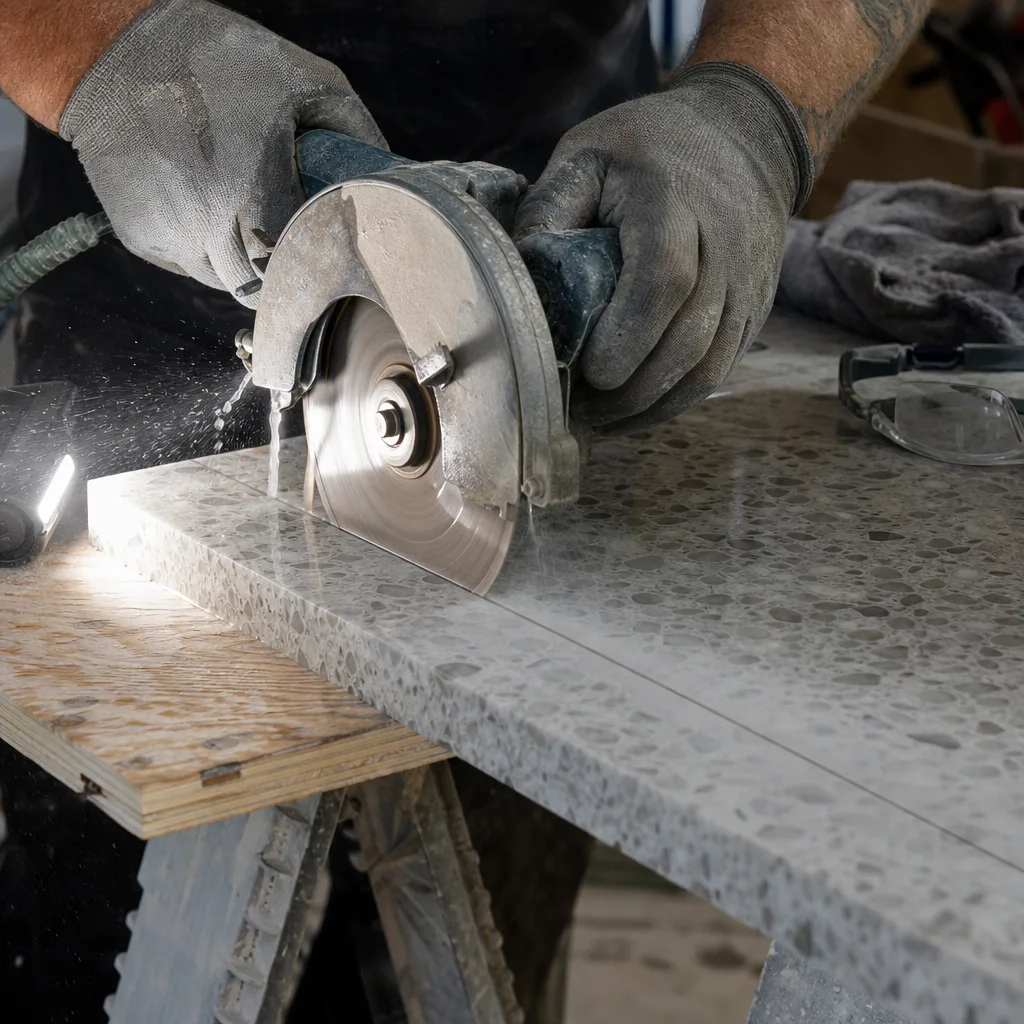
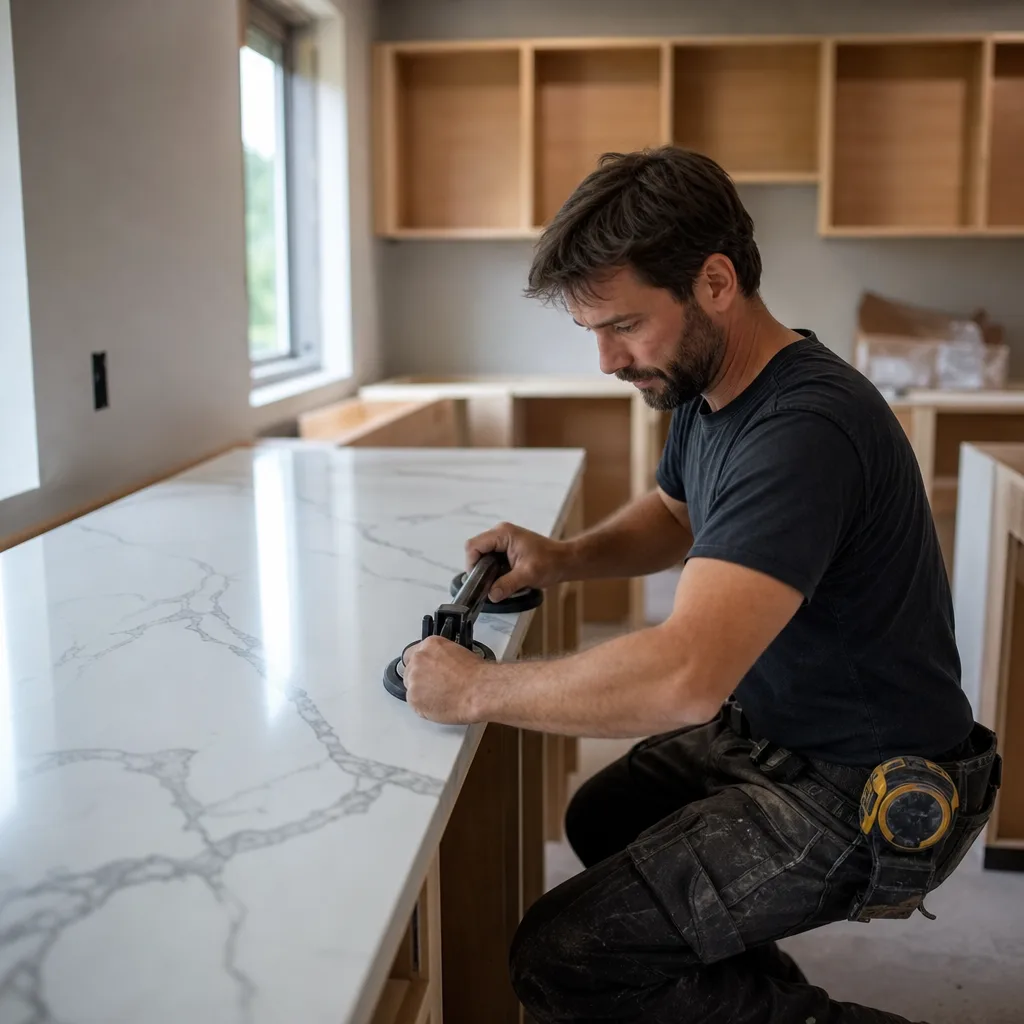
Install day is faster than people expect. The pieces come in, get dry-fit, set in place, and shimmed until they're level. Seams get joined with color-matched adhesive and pulled tight. The sink gets mounted from underneath. Then it sits. Adhesive and silicone need time to cure before you load up the counter or hook the plumbing back up.
A couple of things trip up older Leesburg kitchens. Homes around the historic district downtown often have walls that aren't square and floors that have settled, so pieces get scribed to fit rather than dropped straight in. A full slab is heavy and rigid too. It can't flex around a tight stair turn or a narrow hallway the way plywood can, so the path from the truck to the kitchen gets looked at before anything moves.
Clear the counters and empty the sink cabinet before both visits. Keep pets somewhere else. There's dust during tear-out and the pieces are heavy enough that nobody wants a dog underfoot.
Plan your Leesburg kitchen renovation.
Ready to Get Started?
Not sure whether quartz or granite fits your kitchen? Tell us how you cook and where the light comes in, and we'll tell you straight. Get your free consultation today.
Call (703) 956-8610Coordinating Countertops With Cabinets, Islands, and Backsplash
A quartz slab doesn't get judged on its own. It gets judged against the cabinet doors under it, the backsplash behind it, and whatever's happening on the island. Pick the counter first in a vacuum and you can end up with a beautiful slab that fights everything around it.
The order that works best is cabinets, then counter, then backsplash. Cabinets are the biggest block of color in the room and the hardest thing to change your mind about. Once that color is locked, the counter has a much smaller field of good options, and picking gets easier instead of harder. Backsplash last, because a tile sample is easy to swap and it's the piece that ties the other two together.
A few things we'd point out while you're holding samples:
- Look at samples in your own kitchen, not under showroom lights. A warm white quartz can read yellow next to cool gray cabinets and you won't see it until it's in the room.
- Check the undertone, not just the color. Two whites that both look white on the shelf will clash if one leans pink and the other leans blue.
- Set the sample flat on the cabinet, at counter height. Held up vertically it catches light completely differently.
- Watch it at night with the lights on. A lot of Leesburg kitchens get most of their real use after dark in the winter, and warm bulbs shift everything.
- Decide how much veining you want before you fall for a slab. Heavy movement next to busy cabinet doors and a patterned tile makes a small kitchen feel cluttered.
Islands are where people get the most freedom. Running a different quartz on the island than on the perimeter is a normal move, and it gives the room a center without repainting anything. The usual approach is a quieter surface on the perimeter and the bolder slab on the island, since that's the piece everybody looks at when they walk in. If you're adding an island where there wasn't one, that layout gets settled well before any measuring happens.
Waterfall edges, where the slab turns down the side of the island to the floor, look sharp but they eat material and add seams at the corners. Worth asking about early if you want one, because it changes how much slab the job needs.
On the backsplash, you've got two roads. Tile gives you texture and grout lines. A quartz slab backsplash, either a short four inch piece or run full height to the upper cabinets, gives you a continuous surface with nothing to scrub. Full height behind a range is popular for that reason. If your kitchen has an awkward wall or a window sitting close to the counter, the slab version often handles it more cleanly than trying to cut tile around it.
If you're keeping your cabinets and only changing the counter, bring a door with you when you look at slabs. Take it off the hinges. It's the single most useful thing you can do to avoid a color you'll regret.
Frequently Asked Questions
How long does the whole quartz countertop job take from start to finish?
Can I keep using my kitchen sink while I wait for the new quartz counters?
Do I need to pick new cabinets before choosing my quartz color?
Sources
[1] MSI Surfaces. What Are the Pros and Cons of Quartz Countertops? https://www.msisurfaces.com/blogs/post/2025/06/14/what-are-the-pros-and-cons-of-quartz-countertops.aspx