

What Countertop Installation Actually Involves
Most homeowners in Leesburg think countertop installation starts the day the slab shows up. It doesn't. The job that actually determines whether your counters sit flat, seam cleanly, and hold up for the next 20 years happens before the material ever enters your kitchen.
Here's the sequence we follow on every job, start to finish:
- We template your cabinets and layout with a digital or physical template, capturing every corner, sink cutout, and appliance gap to a fraction of an inch.
- The template goes to the fabricator, who cuts the slab — quartz, granite, or whatever material you've chosen — to that exact shape.
- We inspect the cabinet boxes and add support where needed, especially under any island overhang or peninsula.
- Installation day: the pieces come in, get set, leveled, and seamed with color-matched epoxy.
- Sinks, faucets, and cooktops get cut in and sealed. We do a final level check and clean every surface.
The templating step is where most DIY and inexperienced-installer jobs go wrong. If the template is off by even an eighth of an inch, the seam between two pieces won't line up, or the overhang on an island won't have the support it needs. We've walked into Leesburg kitchens where a previous installer rushed the template, and the homeowner ended up with a visible gap at every seam.
Most standard kitchens in the Lansdowne and River Creek area take one to two weeks from template to install, once the slab is selected. That's typical lead time for fabrication, not something we can rush without cutting a corner that shouldn't be cut. We'll give you a realistic date range at the walkthrough, not an optimistic guess just to win the job.
One thing worth knowing upfront: cabinet condition matters just as much as the countertop material. If your boxes aren't level or solid, no amount of careful fabrication fixes a counter that's sitting on an uneven foundation. We check that before we ever template.
Get the kitchen of your dreams in Leesburg.
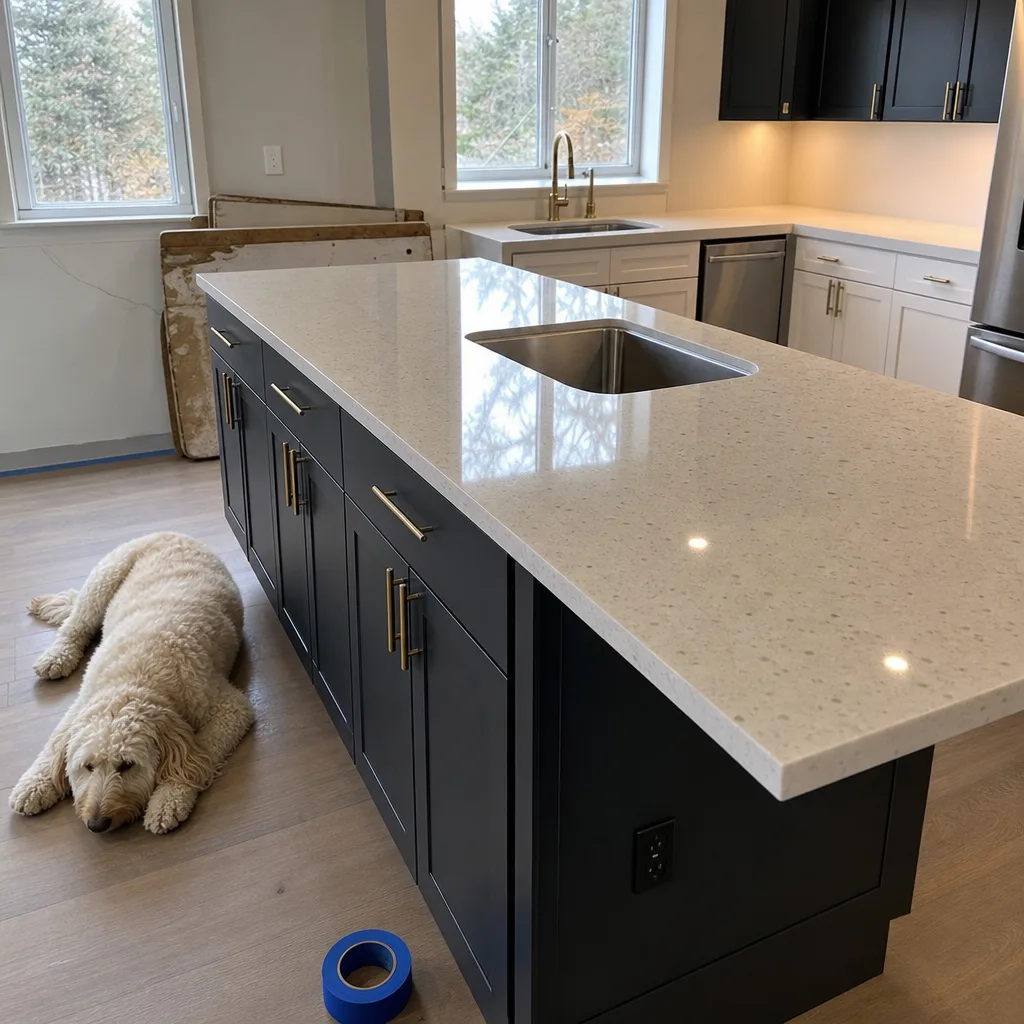
Choosing a Material That Fits Your Kitchen and Your Budget
The material question comes up on every single countertop job we do in Leesburg, and there's no single right answer. It depends on how you cook, how your kitchen gets used, and what you're trying to protect — resale value, daily durability, or a specific look.
Here's how the most common options actually compare:
- Quartz: Engineered, non-porous, and nearly maintenance-free. No sealing required, ever. It handles heat and stains well and holds a consistent pattern slab to slab. The most requested material in Loudoun County kitchens right now.
- Granite: Natural stone with real depth and variation — no two slabs look identical. It needs periodic sealing to stay stain-resistant, but it's held up in kitchens for decades when maintained.
- Quartzite: Also natural stone, harder than granite, and prized for a marble-like look with better heat and scratch resistance than actual marble.
- Butcher block: Warm, budget-friendly, and great for a farmhouse or transitional kitchen, but it needs regular oiling and isn't the right call near a sink without careful sealing.
- Laminate: The most affordable option, and modern laminate has come a long way visually, but it doesn't match the resale impact of stone or quartz.
According to Consumer Reports, countertop performance varies significantly by how a household actually uses its kitchen — heavy cooking and heat exposure favor quartz and granite over laminate and butcher block.[1]
We see a clear pattern in homes around Lansdowne and Ashburn Farm: homeowners planning to stay another 10-plus years often lean toward granite or quartzite for the natural variation, while homeowners thinking about resale in the next few years tend to choose quartz for its consistency and zero-maintenance reputation with buyers.
There isn't a wrong choice here, as long as it matches how your household actually lives. We'll bring real samples to your kitchen so you can see how each option looks under your actual lighting before you commit to anything.
Ready to Get Started?
We bring real slab samples to your kitchen and give you a straight timeline before anything gets ordered. Get your free consultation today.
Call (703) 956-8610Why Cabinet Support Matters More Than Most Homeowners Realize
Here's something that doesn't come up until it's a problem: a countertop is only as stable as what's underneath it. Loudoun County kitchens built in the 1990s and 2000s often have cabinet boxes that were never designed to carry the weight of a full stone slab, especially on an island with a seating overhang.
Granite and quartzite are heavy. A standard kitchen's worth of slab can run several hundred pounds. Quartz isn't far behind. If the cabinet boxes underneath aren't level, solid, and properly braced, that weight finds the weak point — usually a seam that opens up or a corner that sags almost imperceptibly over a year or two.
This is where overhangs need real attention. Any island or peninsula overhang beyond about 10 inches typically needs corbels, steel brackets, or an engineered support bracket system underneath, not just the cabinet box alone. We see homeowners in the Potomac Station area who want a dramatic 15-inch bar overhang for seating, which looks great, but it has to be engineered correctly or it becomes a long-term liability.
We check for a few specific things on every job before we ever template:
- Whether the cabinet boxes sit level against the wall and floor
- Whether any overhang exceeds the safe unsupported limit for the chosen material
- Whether existing cabinets were built for the weight of stone versus a lighter original countertop
- Whether plumbing or electrical in the cabinet base interferes with new support bracing
If we find an issue, we address it before installation day, not after a seam has already opened up. It's a lot cheaper and a lot less disruptive to reinforce a cabinet box in advance than to pull a countertop back off months later.
What to Expect on Installation Day
Installation day moves faster than most homeowners expect, but there's real precision involved at every step.
Here's what actually happens once the fabricated pieces arrive at your Leesburg home:
- Dry fit. We bring each piece in and set it in place without adhesive first, checking that every seam, cutout, and edge lines up exactly as templated.
- Leveling. Shims go under the cabinet boxes wherever needed so the finished surface sits dead level, not just close.
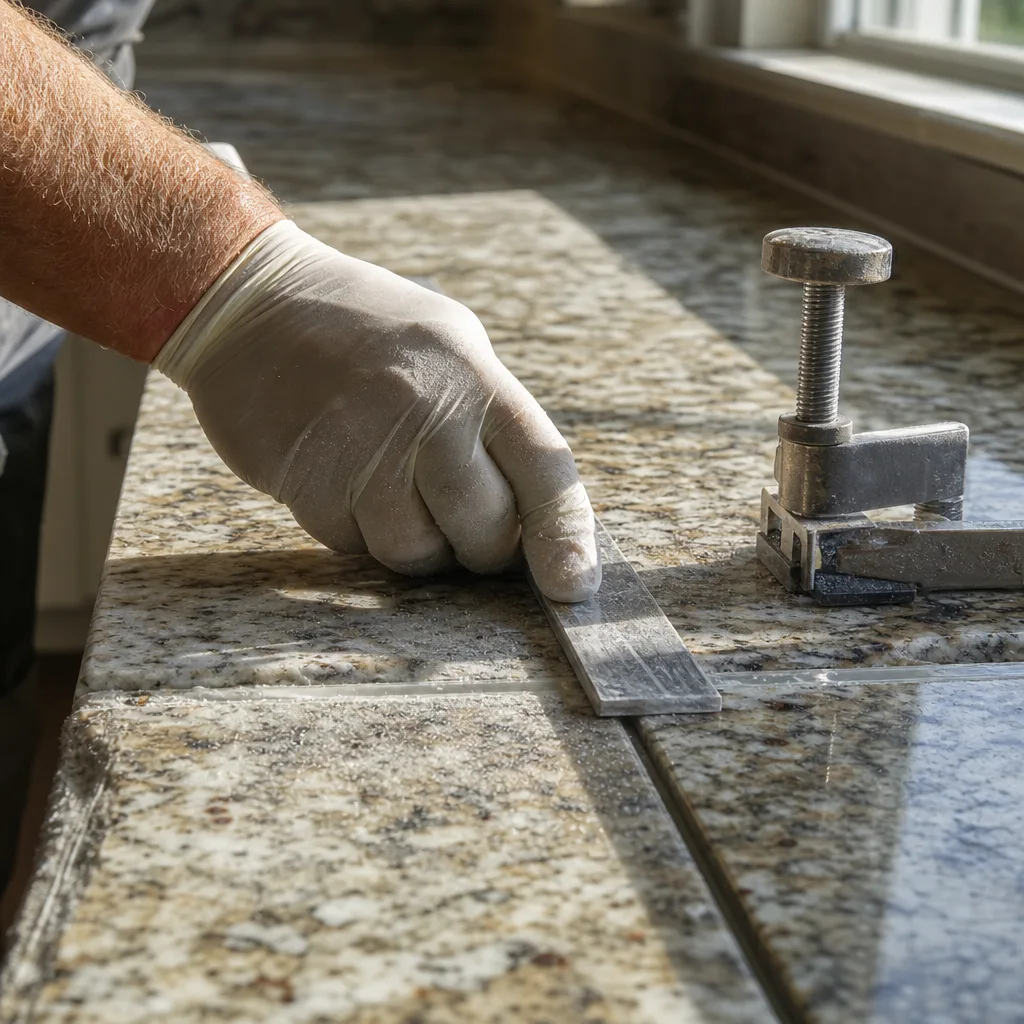
- Seaming. Color-matched epoxy joins each piece. We polish the seam flush so it's a smooth transition, not a visible ridge.
- Sink and cooktop cutouts. Undermount sinks get mounted and sealed; cooktop cutouts get finished and checked for a tight, safe fit.
- Caulking and sealing. Every edge where the counter meets a backsplash or wall gets sealed against moisture.
- Final walkthrough. We go over every seam, edge, and cutout with you before we consider the job done.
Most kitchens in neighborhoods like Kincaid Forest and the Village at Leesburg are fully installed in a single day. Larger kitchens with an island, multiple seams, and a full backsplash sometimes run into a second day for finishing details. Either way, your kitchen isn't out of commission for weeks.
One thing we tell every customer: don't put heavy weight or pressure on the counters for at least 24 hours after seaming, especially near a fresh seam. The epoxy needs time to fully cure before it's load-bearing.
Discover professional home remodeling in Leesburg.
Caring for Your New Countertops Long After Installation
A good countertop installation should mean you're not thinking about your counters again for a very long time. But the first year matters, and ongoing care depends entirely on which material you chose.
Quartz
Daily cleaning is simple: warm water and mild soap. No sealing, ever. Avoid setting extremely hot pans directly on the surface without a trivet — quartz resists heat well but thermal shock from a sudden temperature swing can still cause a crack in rare cases.
Granite and quartzite
These need resealing periodically, typically every one to three years depending on how the stone was finished and how heavily your kitchen gets used. A simple water test tells you if it's time: splash a little water on the surface, and if it darkens the stone within a few minutes instead of beading up, it's time to reseal. Homeowners near Sycolin Road with heavily used kitchens often need resealing closer to the one-year mark.
Butcher block
Regular mineral oil application keeps it from drying out and cracking. Wipe up standing water immediately, especially near a sink area.
Across every material, the same basic habit protects your investment: use cutting boards instead of cutting directly on the surface, wipe up acidic spills like wine or citrus promptly, and avoid abrasive scouring pads that can dull a polished finish over time.
A countertop installed correctly, with the right support underneath and the right material for how your household actually lives, is one of the few kitchen upgrades that genuinely pays for itself — both in daily use and in what a buyer notices the moment they walk in.
Frequently Asked Questions
How long does countertop installation take in Leesburg from start to finish?
Do my existing cabinets need any work before new countertops go in?
Which countertop material holds up best for a busy family kitchen?
How much overhang can an island countertop safely have without extra support?
Will my new countertops increase my home's resale value in Leesburg?
How do I know if my granite countertops need resealing?
Sources
[1] Consumer Reports. Best Countertops for Busy Kitchens. https://www.consumerreports.org/home-garden/countertops/best-countertops-for-busy-kitchens/