
Signs Your Casement Window Needs Replacement
A casement window usually needs replacing when the crank stops working, the frame feels soft or swollen, or cold air sneaks in even when it's shut tight. Ashburn homes built in the late 1990s and early 2000s are hitting the age where original casement units start failing at the seal and hardware. If you're feeling drafts, seeing fogged glass, or fighting the crank every time you open it, your window needs attention.
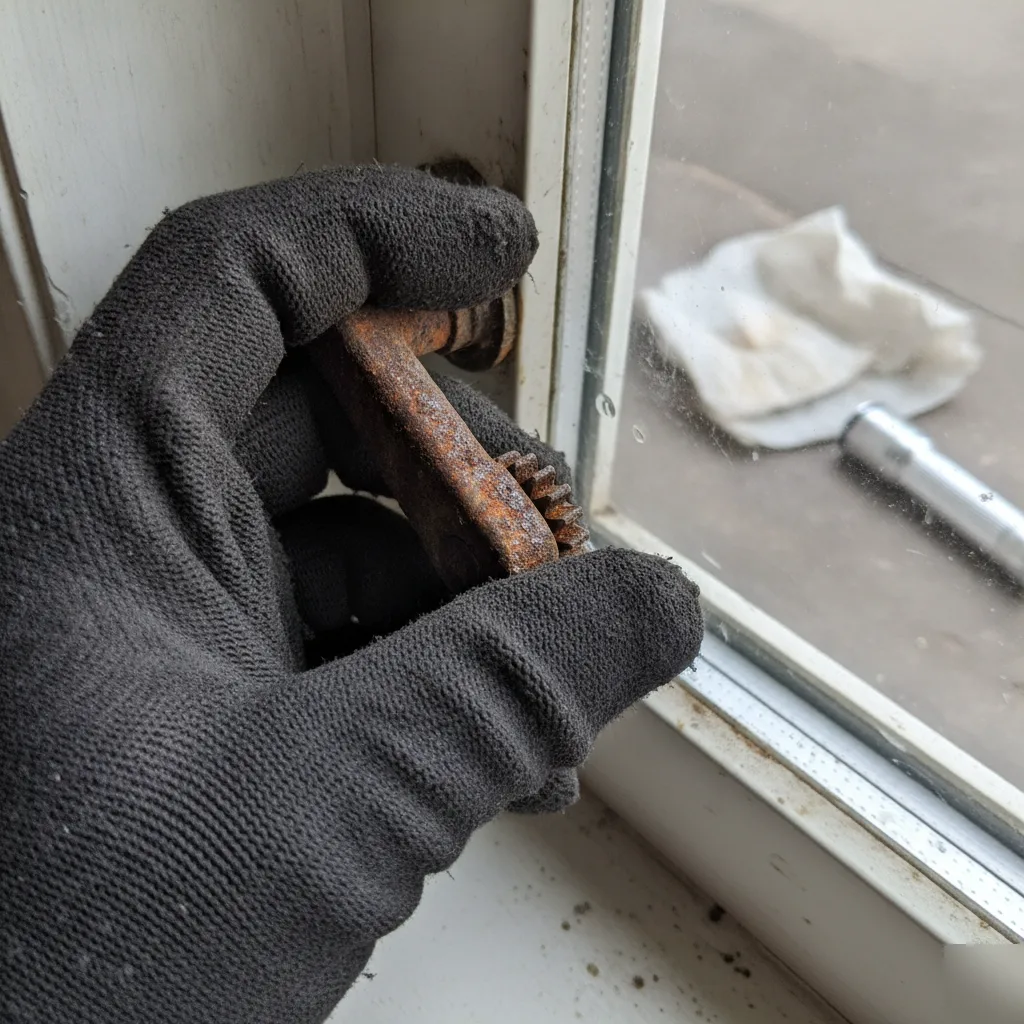
How do you know it's time? It's often the crank. That little handle turns hard, or turns and turns without the sash moving at all. That's the gear mechanism wearing out inside the frame. Once it goes, patching it rarely holds for long.
We see many homes in Ashburn built during the big development years off Waxpool Road and around Broadlands. Those original casement windows are now old enough that the vinyl seals have started to shrink. You'll notice it most in January. Cold air pushes right through a gap you can barely see, and your heating bill creeps up without any other explanation.
- Foggy or cloudy glass between the panes means the seal has failed and moisture got inside.
- Wood or vinyl frame that feels soft, swollen, or shows dark staining near the bottom corner.
- Window won't latch fully closed, or the lock doesn't line up with the strike anymore.
- Visible daylight or a draft you can feel with your hand along the edge of the sash.
- Paint or caulk cracking every season no matter how often you touch it up.
If the frame itself is rotted or warped, that's not a hardware fix, that's a replacement job.
https://www.saltydogremodeling.com/exterior-service-hub
When a Simple Repair Beats a Full Window Replacement
Not every stuck crank means you need new windows. We get calls all the time from folks who think their casement window is done for, and a lot of the time it's not.
If the glass is foggy but the frame is solid, that's usually just a failed seal on the glass unit. Swap the insulated glass and you're set. A crank handle that spins but won't open the window anymore is almost always the operator mechanism, not the window itself. We see this every week, especially on windows from the late '90s and early 2000s. Many homes in Ashburn Village and Belmont Ridge still have their original builder-grade casement windows from that era, and the hardware just wears out before the frame ever does.
One bad hinge, one torn weatherstrip, one cracked pane - none of those call for a full replacement.
Here's where it flips, though. If the frame itself is soft or swollen, water's already gotten into the wood or the sill. No amount of hardware work fixes that. Multiple windows failing at once, drafts you can feel across the room, or a frame that's visibly warped, that's a different conversation. Repair patches a problem, replacement solves it. We'll tell you straight which one you're looking at, because a fifteen-minute fix shouldn't turn into a bigger job than it needs to be.
What to Know Before Casement Window Installation in Ashburn Homes
Before we pick up a tool, there's a short list of things to sort out. Ashburn has a mix of newer subdivisions with vinyl siding and older properties near the town center with wood trim. Each one changes how the job gets planned. Homes built in the last twenty years usually have standard rough openings, older homes sometimes don't.
If your casement window is going into a bedroom, egress code matters. Loudoun County requires a bedroom to have a working means of exit, such as a window, with a sill no higher than 44 inches from the floor [1]. We check that before we order anything. Skip this step and you could end up with a window that looks great but doesn't meet code for a sleeping room.
- Check your HOA rules first. Many Ashburn communities have exterior guidelines on window style and color. Approval can take a couple of weeks.
- Know your frame material. Wood, vinyl, and fiber cement siding each need different flashing and sealing approaches around the new window.
- Ask about the rough opening. If the new casement window doesn't match the old opening size, that's extra carpentry work, not a simple swap.
- Think about the season. Cold, wet weather can slow down sealant curing, so we watch the forecast before scheduling exterior work.
We've walked into plenty of Ashburn homes where the owner assumed it was a quick swap, only to find the old opening was framed slightly out of square. It's an easy fix, but it's better to know going in.
Ready to Get Started?
We'll check egress code, HOA rules, and your rough opening before anything gets ordered. Get your free consultation today.
Call (703) 956-8610The Casement Window Installation Process, Step by Step
This isn't a job where we show up and wing it. Every casement window installation follows the same order for a reason. Skip a step and you risk leaks or a window that won't crank shut right. Here's what happens once we're on site.
- We measure the rough opening again, even if we measured it weeks ago. Framing shifts a little, especially in Ashburn homes from the 1990s where original openings run narrower than what today's casement units need.
- Old window comes out. We check the framing underneath for rot or soft wood before anything new goes in.
- Flashing tape goes around the opening. This is the part nobody sees and it stops water from getting behind your siding.
- The new casement unit gets set, leveled, and shimmed. We check if the swings and cranks smooth before we fasten anything permanently.
- Insulation fills the gap between the frame and the rough opening. Too little and you'll feel drafts, too much and it can bow the frame.
- Exterior trim and caulking finish the outside. Interior trim gets reset or replaced to match.
- We test the crank, the lock, and the seal one more time before we call it done.
Most single-window jobs wrap up in half a day. Add more windows and it stretches out, but each one still gets the same seven steps. We've seen installers rush the flashing step to save time, and it always shows up later as a stain on the drywall inside. Slow down on that one part; it saves you a headache down the road.
How Casement Window Installation Pricing Works
Let's talk about cost, because that's usually the first question anyone asks. Casement window pricing isn't one flat number. It moves based on a handful of real factors. Understanding them helps you ask better questions when you're getting quotes.
Window size matters, obviously. But so does the frame material, the glass package, and how much work the opening itself needs before a new window goes in. A straightforward replacement in an existing opening costs less labor than one that needs the frame rebuilt or resized.
- Frame material: vinyl, wood, and fiberglass all price differently, and each has its own upkeep down the road.
- Glass package: double pane versus triple pane, low-E coatings, and gas fills between panes.
- Opening condition: rot, warped framing, or old lead paint can add prep work.
- Number of windows: doing several at once usually costs less per window than one at a time.
- Trim and siding work: some Ashburn homes need extra flashing or trim repair around the opening.
Older homes around Ashburn sometimes hide surprises once we pull the old sash out - rotted wood, gaps in the framing, that kind of thing. We won't know for sure until we open things up. A good contractor should walk you through what they find before moving forward, not after the bill shows up.
Before you hire anyone, ask what's included in the quote. Does it cover disposal of the old window? Is trim work part of the price or separate? Get that in writing.
A fair quote should break down labor and materials separately, so you can see where your money's going instead of just one lump number.
https://www.saltydogremodeling.com/window-installation-service